 listicle
Affordable Used Cars Columbus Ohio Under 15k: 2026 Guide
Table of Contents
- Quick Comparison: Where to Find Used Cars Under $15k in Columbus
- What to Expect from Used Cars Columbus Ohio Under 15k
- How to Inspect a Used Car Before Buying
- Used Car Financing for Bad Credit: What Actually Works
- Drive Direct vs Ricart Used Cars Comparison
- Total Cost of Ownership: The Math Most Buyers Skip
- Conclusion
- Frequently Asked Questions
Last Updated: September 25, 2026
Quick Comparison: Where to Find Used Cars Under $15k in Columbus
Shopping for affordable used cars Columbus Ohio under 15k means balancing price, mileage, and condition. This guide breaks down where to look, what to inspect, how financing works for imperfect credit, and the real five-year cost.
| Source | Typical Strength | Watch Out For | Best For |
|---|---|---|---|
| Independent lots | Flexible financing, faster approval | Smaller inventory | Buyers with credit challenges |
| Franchised dealer trade-ins | Vehicle history reports, service records | Higher asking prices | Buyers who want documentation |
| National listing sites | Widest selection, price comparison tools | You still negotiate at the lot | Buyers doing homework first |
| Private sellers | Lowest sticker price | No warranty, no financing | Cash buyers who can inspect |
What to Expect from Used Cars Columbus Ohio Under 15k
Expect a 6 to 10-year-old vehicle with 70,000 to 120,000 miles. You gain a car that has absorbed the steepest depreciation; you give up the newest safety tech and sometimes a factory warranty. Certified pre-owned programs occasionally dip into this range, but selection is thin and moves fast.
Mileage, Model Year, and Body Style Trade-Offs
Mileage matters less than maintenance history. A 110,000-mile sedan with documented oil changes usually outlasts a neglected 70,000-mile one.
- Sedans: Best value per dollar, cheapest to insure, easiest to park
- SUVs: Higher seating position, more cargo room, slightly worse fuel efficiency
- Trucks: Strong resale, but budget examples often carry heavy work miles
- Hatchbacks: Practical compromise, often overlooked and therefore underpriced
How to Inspect a Used Car Before Buying
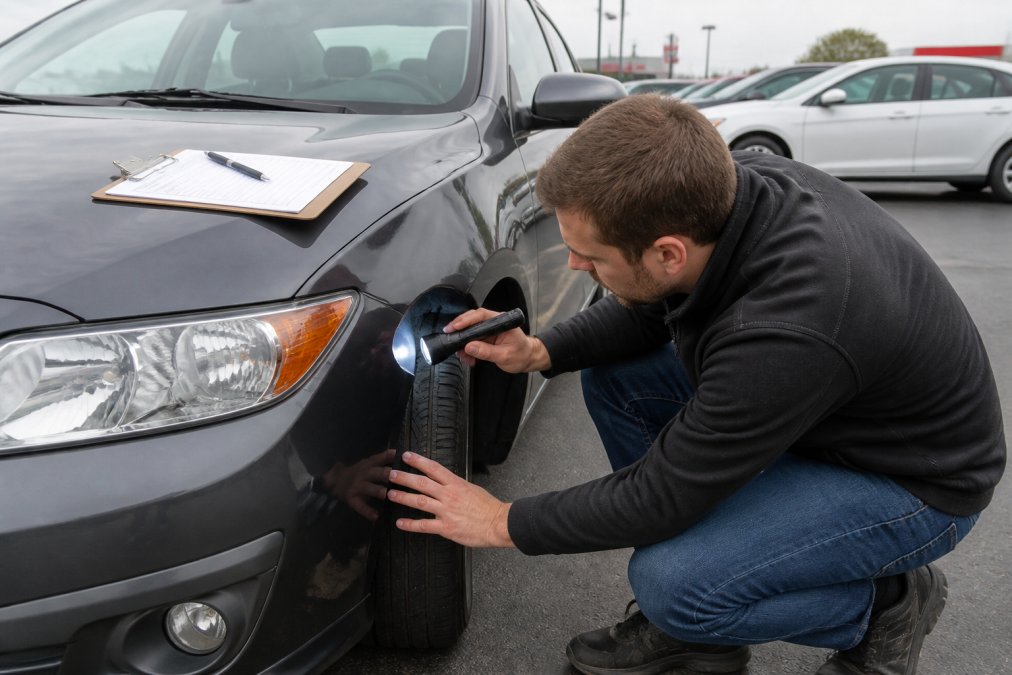
Most budget listings live or die on condition, not price. A sub-$15k car with a clean history and documented maintenance beats a cheaper twin with a rebuilt title. Separate the two in three stages: a walkaround, a records check, and a paid pre-purchase inspection by an independent mechanic.
Stage 1: The 15-Minute Walkaround
Do this in daylight, on dry pavement, before you drive anything. Bring a flashlight, a magnet for body filler, a tire tread gauge, and a rag for fluids.
- Check panel gaps and paint shade under direct sun for accident repair
- Run a magnet along wheel arches and rocker panels; it should stick evenly
- Look for rust along wheel arches, rocker panels, and the trunk lip
- Inspect tire tread depth and confirm all four tires match in brand and wear
- Check for fluid drips under the engine bay and near the transmission
- Test every light, window, lock, and seat adjustment
- Start the engine cold and listen for knocking or rough idle
- Check the oil, coolant, and transmission fluid color
- Look at the brake rotors for deep grooves or heavy lip
- Open and close every door, the hood, and the trunk; listen for crunch or misalignment
Stage 2: The Records Check
Before you pay a mechanic, spend twenty minutes on paperwork. Ask the seller for:
- The title, in hand, with the VIN matching the dashboard plate
- A vehicle history report from a major provider
- Service records, ideally with dates and mileage
- The most recent emissions or safety inspection, if your state requires one
- Recall status by VIN through the National Highway Traffic Safety Administration's recall lookup
Stage 3: The Paid Pre-Purchase Inspection
This is the step budget buyers skip and regret. An independent mechanic, not the seller's shop, should put the car on a lift and check:
- Compression and leak-down on the engine
- Transmission fluid condition and shift behavior on a test drive
- Suspension bushings, ball joints, tie rods, and CV boots
- Brake pad and rotor thickness against spec
- Frame and unibody for prior collision repair
- A scan for stored trouble codes, including pending and permanent ones
- A/C and heat output at the vents
How to Use the Inspection to Negotiate
Sort the list into three buckets: safety, near-term maintenance, and cosmetic. Safety items are non-negotiable. Near-term maintenance, tires, brakes, a timing belt, is where you ask for a price reduction. Cosmetic issues are leverage, not dealbreakers. Sellers typically cover the first bucket and split the second. If they won't move on documented safety issues, walk; there's always another listing.
A Note on High-Mileage Cars in This Price Range
At 70,000 to 120,000 miles, the inspection matters more than the odometer. A well-maintained 120,000-mile sedan with records often outlasts a neglected 70,000-mile one. Check reliability ratings by model year before you buy, they filter better than mileage alone. If a model year has a known transmission or timing chain issue, no inspection makes it a good deal.
Used Car Financing for Bad Credit: What Actually Works
Financing for imperfect credit works when the lender weighs income and stability, not just a score. Many dealerships work with lenders who consider down payment, job history, and residency. The practical sequence:
- Get pre-qualified before you shop, so you know your realistic monthly payment
- Bring proof of income, a utility bill, and a valid ID
- Expect a larger down payment to offset a lower credit tier
- Ask about the annual percentage rate and the total finance charge, not just the payment
- Confirm there are no hidden fees added at signing
Drive Direct vs Ricart Used Cars Comparison
Comparing Drive Direct vs Ricart used cars comes down to format, not just price. One is a large-volume retail group; the other leans toward a simplified buying model. Both move inventory quickly, so the real question is which format fits how you like to buy. What most comparisons miss: the format matters less than the specific car. A well-documented example at either lot beats a cheaper one with a murky history.
| Factor | Large-Volume Group | Simplified Format |
|---|---|---|
| Inventory size | Very large, fast turnover | Smaller, curated |
| Negotiation | Traditional back-and-forth | Often more fixed pricing |
| Financing desk | Multiple lender options | Usually fewer lenders |
| Time on site | Can run long on busy days | Generally shorter |
| Trade-in process | Appraisal on site, often same day | Appraisal on site, sometimes outsourced |
| Best for | Comparison shoppers | Buyers who dislike haggling |
What Actually Drives the Price Difference
Three things move the number more than the dealership format:
- How the car was acquired. Trade-ins and off-lease units usually come with more documentation than auction cars. That documentation is worth real money at resale.
- Reconditioning spend. A lot that replaced brakes, tires, and fluids before listing is asking more because it spent more. Ask what was done and get it in writing.
- Days on lot. A unit that has sat for 60 days is more negotiable than one that arrived last week, regardless of which format you are standing in.
The Financing Variable
This is where the formats diverge most for budget buyers. A large-volume group typically has a finance department with relationships across many lenders, including subprime and near-prime programs. A simplified-format lot may work with a smaller lender panel, fewer options if your credit is imperfect. If credit is a factor, ask two questions before committing:
- Which lenders does your finance desk work with for my credit tier?
- Can I see the annual percentage rate and total finance charge in writing before I sign?
Where a Credit-Focused Lot Changes the Math
This is where a smaller, credit-focused lot changes the math. Buy & Buy Auto Sales offers financing options regardless of credit history, no hidden fees, down payment flexibility, and flexible terms, plus a stress-free buying process built to get you pre-qualified in minutes. This means you spend your time choosing a vehicle instead of waiting on a finance decision, and the number you discuss is closer to the number you sign.
A Practical Way to Compare Both
Pick three cars across the two formats that match your budget and body style. Pull the history report on each, ask for the reconditioning list, and get a pre-qualification from each finance desk. Compare the out-the-door number, not the sticker. The format that wins gives you the cleanest car at the lowest total cost, and that answer changes from shopper to shopper.
Total Cost of Ownership: The Math Most Buyers Skip
The sticker price is roughly 60% of what you'll spend. The rest hides in insurance, fuel, maintenance, and depreciation, where budget buyers get surprised. Run this estimate before you commit:
- Insurance: Get a quote on the exact VIN, not the model
- Fuel: Estimate annual miles divided by combined MPG, times current gas prices
- Maintenance: Budget for tires, brakes, fluids, and one unexpected repair per year
- Depreciation: A 7-year-old car loses far less value per year than a 3-year-old one
- Registration and taxes: Check current state and county fees directly
Conclusion
Finding a dependable vehicle under 15k takes patience, a checklist, and financing you understand before you walk onto a lot. Most buyers lose money on the two things they skip: the inspection and the total cost math.
Frequently Asked Questions
What is the best used car to buy for under $15,000?
There is no single best model, but the smartest picks share traits: a strong reliability record, parts that are cheap to replace, and a clean vehicle history report. Midsize sedans and compact SUVs from mainstream brands tend to hold up well because repair networks are widespread. Before buying, check mileage against the model year, request a Carfax report, and have a mechanic inspect the drivetrain and transmission. A well-documented car with higher miles often beats a low-mileage car with a sketchy past.
How can I get used car financing for bad credit?
Start by getting pre-qualified before you shop so you know your realistic price range. Many dealerships work with lenders who approve buyers regardless of credit history, though interest rates will be higher than prime rates. A larger down payment lowers your monthly payments and improves approval odds. Bring proof of income, a valid ID, and recent bank statements. Ask directly about fees and terms, since a longer loan lowers the payment but increases total interest paid over the life of the loan.
What should I look for when inspecting a used car under $15,000?
Check the tires for uneven wear, which can signal alignment or suspension problems. Look for rust along wheel wells and under doors, and check that body panel gaps are even, a sign of past collision repair. Inside, test every button, the AC, and the infotainment system. Under the hood, check fluid colors and look for leaks. Ask for maintenance records and a vehicle history report. A pre-purchase inspection by an independent mechanic is the best money you will spend.
What are the hidden costs of buying a used car?
Beyond the sticker price, budget for sales tax, title and registration fees, and a documentary fee, which vary by state and dealer. Ask whether a warranty is included or costs extra. Factor in immediate maintenance like new tires, brakes, or fluids, plus ongoing costs: insurance, fuel, and repairs. A total cost of ownership estimate for the first year often runs well above the purchase price, so leave room in your budget rather than spending your last dollar on the car itself.
How do I compare dealership inventory for budget-friendly vehicles?
Use online inventory search tools to filter by price range, make and model, mileage, and body style, then shortlist three to five vehicles. Compare listings on mileage, vehicle condition notes, and whether a vehicle history report is provided. Call ahead to confirm the car is still on the lot and ask about financing options and any fees. A dealership that answers pricing and history questions upfront saves you a wasted trip and makes the test drive more productive.