 Listicle
Narrow City Parking: Best Used Cars That Fit Tight Spaces
Last Updated: November 15, 2026
Quick Summary
The best used cars for narrow city parking are compact hatchbacks and small crossovers chosen by width, door swing, and turning radius, not by badge. Measure your actual space and the car with mirrors before you shop, then test the door in a real spot. Models like the 2012 Honda Fit and Hyundai Venue suit narrow city parking well.
- Measure your parking space at its narrowest point before you start shopping for a car.
- Published width figures usually exclude mirrors and ignore door swing clearance.
- A two-door coupe with long doors needs more side clearance than a four-door hatchback.
- Smaller curb-to-curb turning circle numbers make garage entry and U-turns easier.
- Test every parking aid in the actual space you will use before buying.
Table of Contents
- Why Narrow City Parking Demands a Different Shortlist
- Cars by Width: The Measurement That Decides Fit
- Best Used Small Cars Under $10,000 for Tight Parking
- Best Used Compact Cars Under $20,000 for City Driving
- Best Cars for Tight Parking: Maneuverability and Visibility
- Fuel Economy, Reliability, and Ownership Costs in the City
- What to Inspect Before Buying a Used Car for Urban Parking
- Get Pre-Qualified at Buy & Buy Auto Sales
- Frequently Asked Questions
Why Narrow City Parking Demands a Different Shortlist
The best used cars for narrow city parking spaces are not simply the cheapest or the smallest cars on the lot. They are the models whose width, turning radius, and visibility match the spaces you actually park in every day.
A Mortgage Bankers Association parking inventory study found that parking-space planning often assumes roughly 20 square meters for on-street surface spaces and 30 square meters for off-street spaces. That sounds generous until you factor in door clearance, mirrors, and the car parked next to you.
Here is the core problem most guides skip: a compact label on a spec sheet tells you almost nothing about fit. Below, we break down the measurements that matter, the models worth shortlisting, and what to check before you sign.
Cars by Width: The Measurement That Decides Fit
Width is the number that decides whether you can open your door and get out. Length matters for parallel spots, but width and door swing are what turn a tight lot into a daily headache.
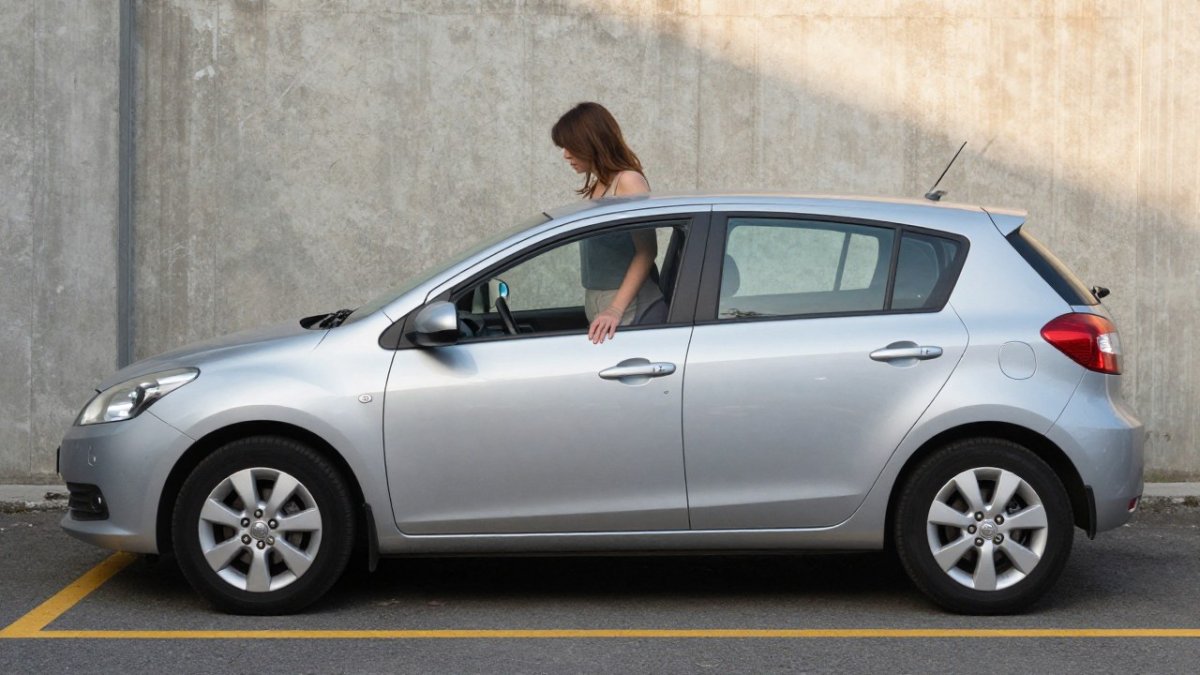
Parking-Space Dimensions vs. Vehicle Width
Start with the space, not the car. Measure the space you park in, since stall sizes vary by lot, and curbside or older garage spots are often tighter than newer ones. Measure your actual space at the narrowest point, between a wall and a pillar, or between the painted lines, and write the number down before you shop.
Manufacturers publish width without mirrors. A car that looks fine on paper can still trap you against a wall once door swing is considered. Mirror width also adds to the real footprint.
Door-Opening Clearance and Turning Radius
Door swing is the hidden variable. A two-door coupe with long doors needs more side clearance than a four-door hatchback with shorter rear doors, even when the two cars are the same width. If you routinely park against a wall on the driver's side, sit in the car and open the door to its first detent, then judge whether you can actually slide out.
Turning radius matters more than most buyers expect. A car that needs three points to enter a garage costs you time every single day. Turning circle is usually published as curb-to-curb, and smaller numbers are better in tight structures. Rear visibility and a backup camera help, but they do not shrink the vehicle. Check the turning circle and sit in the driver's seat to judge sightlines before you commit.
Watch out: published width figures often exclude mirrors and do not account for door swing, so a car that fits the stripe can still be impossible to exit in a narrow garage. Measure the space, measure the car with mirrors, and test the door in a real spot before you sign.
Best Used Small Cars Under $10,000 for Tight Parking
Two credible under-$10,000 picks stand out from U.S. News & World Report's used small-car rankings. Both are hatchback or compact designs that suit tight lots and narrow city roads.
2012 Honda Fit: The Hatchback That Fits
The 2012 Honda Fit is a hatchback with a small footprint and upright seating. Best for: first-time buyers who want a practical city car. Skip if: you need serious cargo capacity.
2011 Chevrolet Volt: Lower Price, Higher MPG
The 2011 Chevrolet Volt is known for strong city fuel economy in stop-and-go traffic. The tradeoff is that early Volt models carry battery and charging-system questions, so a pre-purchase inspection is essential.
For more trusted low-mileage options in this budget, see our guide to 7 Low Mileage Used Cars Under $10,000 You Can Trust.
Best Used Compact Cars Under $20,000 for City Driving
Raising the budget to $20,000 opens up newer compact sedans and small crossovers with better safety tech and parking aids. Here is how the main options compare.
| Model | Body Style | City Strength | Watch For |
|---|---|---|---|
| Honda Civic | Compact sedan | Everyday commuting | Verify trim and year |
| Toyota Corolla | Compact sedan | Simple, proven layout | Check service history |
| Honda HR-V | Small crossover | Visibility and cargo room | Confirm exact dimensions |
| Hyundai Kona | Small crossover | Compact-only parking | Verify used pricing |
| Mazda CX-30 | Small crossover | City maneuverability | Confirm trim features |
Honda Civic and Toyota Corolla: The Commuter Standbys
Both the Honda Civic and Toyota Corolla are named as practical everyday-commuting choices in AutoSavvy's used-car buying guide. Neither is the narrowest car you can buy, but both are easy to maneuver and cheap to maintain. Best for: commuters who want proven reliability. Skip if: your space is genuinely narrow, since a sedan's door swing still needs room.
Honda HR-V and Hyundai Kona: Small Crossovers With Visibility
The Honda HR-V is described by Nalley Cars' limited-parking guide as a small crossover with a compact footprint, good visibility, and cargo room. The Hyundai Kona appears in CarSeek's city-car and parking guide in the context of compact-only parking. Both raise your seating position, which helps rear visibility in tight lots.
Best Cars for Tight Parking: Maneuverability and Visibility
The best cars for tight parking combine a short turning circle, good rear visibility, and parking aids you will actually use. A backup camera and parking sensors reduce stress, but they do not replace checking the actual space.
Turning Radius and Steering Feel
Turning circle is the spec that separates two cars of similar size. Smaller curb-to-curb numbers make U-turn and garage-entry maneuvers easier, and a tight steering lock helps in angled structures. When you test drive, find an empty lot and try a full-lock turn at low speed; if the car feels wide or the steering needs extra input, it will feel worse in a crowded garage. Front-wheel-drive compact hatchbacks and small crossovers tend to feel more nimble than longer sedans, but the published turning circle is the number to compare.
Visibility and Parking-Assist Features by Model Year
Visibility is not just about the rear window. Thick pillars, high beltlines, and small rear glass can hide a curb or a bollard. Sit in the driver's seat and check the view over each shoulder and through the rear glass. Camera resolution and screen size vary widely, so check the specific vehicle. Parking sensors and cross-traffic alert are often tied to trim, so verify the exact trim and model year rather than assuming a badge includes them.
The Hyundai Venue is described by CarGurus' tiny-car research as short, light, and nimble in city traffic. That combination is what makes a car easy to maneuver in narrow parking structures. Our advice: prioritize turning radius and sightlines over a badge or a bigger screen, and confirm the parking aids on the specific car you are buying.
Watch out: parking sensors and cameras can fail or be damaged on a used car, and a clean screen does not guarantee a working system. Test every parking aid in the actual space you will use before you buy.
Fuel Economy, Reliability, and Ownership Costs in the City
City driving punishes fuel economy. Stop-and-go traffic, idling, and short trips all drag real-world mpg below the highway figure on the window sticker. City fuel economy matters because stop-and-go traffic lowers real-world mpg below highway figures.
Reliability and ownership costs matter just as much as purchase price. A cheaper car with a costly repair history is not a bargain. Factor in insurance, tires, and expected maintenance before you decide. For a deeper list of efficient options, browse our roundup of the 10 Best Fuel Efficient Used Cars for 2026, and use our 7 Steps to Check Used Car Reliability Before You Buy to verify a specific vehicle.
What to Inspect Before Buying a Used Car for Urban Parking
Inspect the car in a space like the one you park in daily. A test drive in an open lot tells you nothing about a narrow garage. Bring a tape measure, check door clearance against a wall, and reverse into a tight spot yourself.
Watch out: skipping a pre-purchase inspection to save time can hide frame damage, worn suspension, or failing parking sensors that make tight parking worse. Run a full used-car checklist before you commit; our What to Check When Buying a Used Car: 2026 Guide walks through every step.
Get Pre-Qualified at Buy & Buy Auto Sales
Finding a car that fits your space and your budget should not be a fight. At Buy & Buy Auto Sales, we offer financing options regardless of credit history, no hidden fees, down payment flexibility, and flexible terms. You can get pre-qualified in minutes and get behind the wheel faster.
Ready to shortlist a compact car that actually fits? Start with our steps to get pre-approved for a car loan in Columbus, then come see the difference a straightforward dealership makes.
Narrow parking spaces do not have to limit your choices. Buy & Buy Auto Sales helps Columbus buyers match the right compact or small crossover to their real parking situation, with financing options regardless of credit history and no hidden fees. Get pre-qualified in minutes and drive home a car that fits.
Frequently Asked Questions
How wide is a typical parking space, and how does that affect narrow city parking?
Real-world parking dimensions vary by lot and city code. Because space width is not standardized everywhere, measure your actual spot before you shop. A vehicle that fits one apartment lot may not fit another. Check the door-opening clearance on both sides, not just the vehicle width, since a tight space with a wall on one side can make a narrow car feel wide.
Which used cars are the narrowest for tight parking?
The research does not provide a consistent, model-by-model width comparison, so verify each vehicle's dimensions against your space. Several compact models are commonly considered for city driving, but confirm width and turning radius on the specific model year you are considering. Always confirm width and turning radius on the specific model year you are considering.
Are small cars easier to park in the city?
Smaller dimensions generally help, but compact size alone does not guarantee easy parking in every narrow space. Small cars can be easier to park in tight spaces, but measurements vary by model. Turning radius, rear visibility, and available parking sensors or backup cameras matter as much as overall length. Test-park the exact vehicle in a space similar to yours before you buy.
What should I check when buying a used car for city driving?
Check the vehicle's width and length against your actual parking space, and confirm the turning radius for your daily routes. Inspect rear visibility and whether the trim has a backup camera or parking sensors. Review maintenance records and reliability for that model year, since city stop-and-go traffic stresses the transmission and brakes. Factor in ownership costs beyond purchase price, including insurance and expected repairs. A pre-purchase inspection by an independent mechanic is worth the fee on any used car.
Are compact cars or subcompact SUVs better for tight parking?
It depends on the specific space and the driver's priorities. Compact sedans and hatchbacks like the Honda Civic and Toyota Corolla are commonly considered practical commuter choices, while small crossovers like the Honda HR-V offer a compact footprint and good visibility. Subcompact SUVs sit higher, which can help visibility, but they may be wider than a hatchback. Compare the actual width, turning circle, and door clearance of the exact models you are considering rather than choosing by body style alone.