 listicle
Best Used Cars for First Time Buyers: 2026 Guide
Table of Contents
- Top Used Cars for First Time Buyers: Quick Comparison
- 1. Honda Civic (2014-2019): The Commuter Standard
- 2. Toyota Corolla (2015-2020): Built for Low Maintenance
- 3. Toyota Camry (2014-2019): Room to Grow
- 4. Subaru Crosstrek: All-Weather Confidence
- 5. Nissan Leaf SV Plus (2023): Electric on a Budget
- 6. Honda Accord: Comfort for Longer Commutes
- 7. Chevy Equinox: Practical Compact SUV
- How to Finance a Used Car for the First Time
- Private Seller vs. Dealership: What First-Time Buyers Should Know
- Budgeting Beyond the Sticker Price
- Test Drive and Mechanical Inspection Tips
- Trade-In and Negotiation Strategies
- Frequently Asked Questions
Last Updated: October 7, 2026
Top Used Cars for First Time Buyers: Quick Comparison
Finding the best used cars for first time buyers comes down to three things: reliability, low running costs, and a price that won't wreck your budget. The smartest buyers pick a proven model, get it inspected, and line up financing before they ever step on the lot.
That's the whole game. Get those three things right and you avoid the trap most new buyers fall into: falling for a shiny car with a hidden problem.
Here's the short list of used cars that consistently deliver for people buying their first vehicle:
| Model | Body Style | Best For | Standout Strength |
|---|---|---|---|
| Honda Civic (2014-2019) | Sedan | Daily commuting | Fuel economy, resale value |
| Toyota Corolla (2015-2020) | Sedan | Low maintenance | Repair frequency |
| Toyota Camry (2014-2019) | Midsize sedan | Growing families | Cabin space |
| Subaru Crosstrek | Subcompact SUV | Bad weather | All-wheel drive |
| Nissan Leaf SV Plus (2023) | Electric hatchback | Fuel savings | Low operating costs |
| Honda Accord | Midsize sedan | Long commutes | Build quality |
| Chevy Equinox | Compact SUV | Cargo and tech | Cargo capacity |
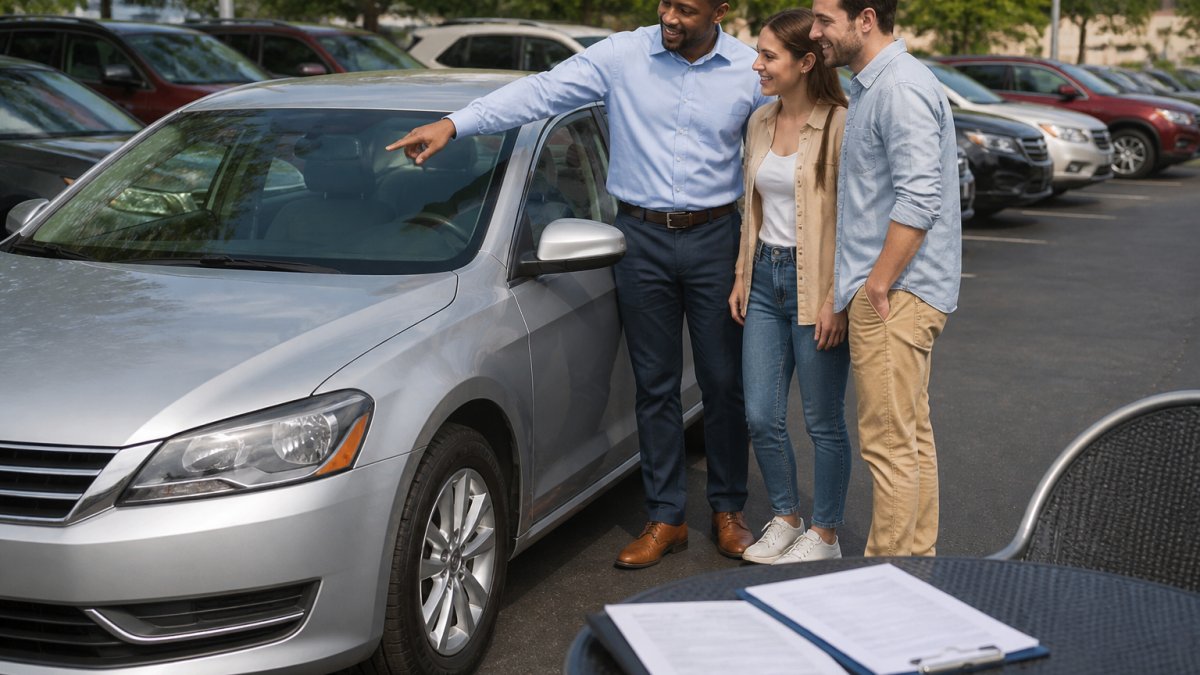
Before you shop, run a used car inspection checklist from NHTSA so you know exactly what to look at on any vehicle.
1. Honda Civic (2014-2019): The Commuter Standard
The Civic earns the top spot because it nails the basics. Fuel economy stays strong, safety ratings hold up, and the engine keeps going well past 150,000 miles with routine care.
What most guides miss is the demand problem. Because everyone wants a Civic, clean examples sell fast and often carry a premium. Expect to pay more than a comparable Corolla of the same year.
2. Toyota Corolla (2015-2020): Built for Low Maintenance
If your priority is a car that rarely sees the inside of a repair shop, the Corolla is your pick. Standard safety features across most trims, simple controls, and exceptional engine durability make it a stress-free daily driver.
The trade-off is honest: driving dynamics are dull. You won't get thrills, but you also won't get surprise repair bills. Parts are cheap and any shop can service it.
3. Toyota Camry (2014-2019): Room to Grow
Need space for passengers or cargo? The Camry delivers a roomy cabin, a smooth ride, and a strong safety record. It's the natural upgrade if you're planning a family or carpooling.
One caveat: the larger footprint makes parking trickier for new drivers. Practice in empty lots before you commit.
4. Subaru Crosstrek: All-Weather Confidence
Standard Symmetrical All-Wheel Drive and extra ground clearance make the Crosstrek the go-to for rain, snow, and rough roads. Visibility is excellent, and the hatchback cargo area handles groceries or gear with ease.
Acceleration feels sluggish next to rivals, so don't buy it expecting speed. Buy it for grip and peace of mind.
5. Nissan Leaf SV Plus (2023): Electric on a Budget
Want to skip gas stations entirely? The Leaf SV Plus pairs zero-emissions driving with advanced driver-assistance features and hatchback utility. Operating costs run low, and the ride is quiet and smooth.
The catch is range. If your commute is short and you can charge at home, it's a smart money-saver. If you take long road trips, stick with gas.
6. Honda Accord: Comfort for Longer Commutes
The Accord balances performance, reliability, and a refined cabin. Generous trunk space and responsive handling make long commutes far more pleasant than a compact sedan.
Insurance tends to cost more than on smaller cars, so factor that into your monthly budget.
7. Chevy Equinox: Practical Compact SUV
For buyers who want modern tech and cargo room, the Equinox fits five comfortably with an intuitive infotainment system. Available safety packages add extra confidence for new drivers.
Interior materials feel less premium than some rivals, but the value and usability hold up.
How to Finance a Used Car for the First Time
Financing is where first-time buyers lose the most money, not on the sticker, but on the loan. Walk in with a pre-approval from your bank or credit union before you ever look at a car. That single move turns you from a captive shopper into a cash-equivalent buyer and gives you a rate to beat.
Here's the sequence that works:
- Pull your credit reports at AnnualCreditReport.com and dispute any errors. A single corrected collection account can move your score enough to change your rate tier.
- Get pre-approved at a bank or credit union for a specific dollar amount and term. Ask for the annual percentage rate (APR), not just the monthly payment.
- Shop the loan separately from the car. You can negotiate the vehicle price and the financing independently, dealers make money on both, and bundling hides the markup.
- Compare at least three offers before signing. A one-point APR difference on a five-year loan adds up fast.
The traps that catch first-time buyers
Subprime lender add-ons. Once you're in the finance office, expect pressure to buy gap insurance, extended warranties, paint protection, and VIN etching.
Payment packing. The finance manager asks "what monthly payment works for you?" and then stretches the loan to 72 or 84 months to hit that number.
Yo-yo financing. You sign, drive home, and get a call the next day saying the lender declined and you need to re-sign at a higher rate.
What a fair deal looks like
Ask for the "out-the-door" price in writing before you discuss financing. That number includes the vehicle, taxes, title, registration, and any dealer fees. Once you have it, you can compare loan offers apples to apples.
A auto loan calculator from the Consumer Financial Protection Bureau lets you plug in the APR and term to see the real total cost before you commit.
Private Seller vs. Dealership: What First-Time Buyers Should Know
A private party sale often means a lower sticker price, but you handle the inspection, paperwork, and title transfer yourself. A dealership handles registration, offers warranty coverage on certified pre-owned vehicles, and provides financing in one place.
For first-time buyers, the dealership route removes most of the risk. You get a mechanical inspection, a vehicle history report, and someone to call if something goes wrong.
| Factor | Private Seller | Dealership |
|---|---|---|
| Price | Often lower | Higher, but negotiable |
| Inspection | Your responsibility | Usually included |
| Financing | You arrange it | On-site options |
| Paperwork | You handle title transfer | Handled for you |
| Recourse | Limited | Warranty and support |
Budgeting Beyond the Sticker Price
The purchase price is the smallest number in the deal. What actually determines whether a used car is affordable is the five-year total cost of ownership (TCO): depreciation, fuel, insurance, maintenance, repairs, and financing interest. Most first-time buyers only see the first one.
Here's how the categories stack up for a typical compact sedan versus a compact SUV versus an EV:
| Cost Category | Compact Sedan (e.g., Civic, Corolla) | Compact SUV (e.g., Crosstrek, Equinox) | Used EV (e.g., Leaf) |
|---|---|---|---|
| Depreciation (5 yr) | Moderate, strong resale on Honda/Toyota | Steeper than sedans | Steepest, EV tech ages fast |
| Fuel / energy | Lowest of the three | 15-25% more than a sedan | Lowest if you charge at home |
| Insurance | Lowest | Higher, larger vehicle, higher repair costs | Often highest, battery repair costs |
| Routine maintenance | Oil, filters, brakes, tires | Same plus AWD service | No oil changes; tires and cabin filter only |
| Major repair risk | Timing belt/chain, transmission | Head gasket, AWD components | Battery degradation out of warranty |
| Financing interest | Lowest loan amount | Mid | Highest loan amount |
The five-year maintenance reality
Routine maintenance on a well-chosen compact sedan typically runs a few hundred dollars a year for the first several years, oil changes, tire rotations, brake pads, and the occasional fluid service.
The bigger variable is the previous owner. A car with a documented maintenance history is worth more than the same model with a blank service record. Ask for receipts, not reassurances.
The costs nobody warns you about
- Insurance for a new driver. Rates for drivers without a long clean record are meaningfully higher than for experienced drivers. Get quotes on the specific make, model, and trim before you buy, not after.
- Registration and taxes. These vary by state and are due at purchase, not spread across the loan.
- A maintenance reserve. Set aside a small monthly amount from day one. When the tires or brakes come due, you'll have the cash instead of a credit card balance.
- Depreciation curve. The steepest drop happens in the first few years. A three- to five-year-old model lets the original owner absorb that hit.
Check reliability ratings and fuel efficiency for any model before you commit. A fuel economy guide from the U.S. Department of Energy lets you compare real-world costs side by side.
When you're ready to put all of this into practice, Buy & Buy Auto Sales is built for exactly this moment, financing guidance for first-time buyers, and a team that will walk you through the out-the-door number before you sign anything.
Test Drive and Mechanical Inspection Tips
Always test drive on both city streets and highways. Listen for unusual noises, check that brakes feel firm, and confirm the air conditioning and electronics work.
Bring a trusted mechanic for a pre-purchase inspection. It's the cheapest insurance you'll ever buy. Research the vehicle history report for accidents, flood damage, or odometer rollback before you hand over any money.
Trade-In and Negotiation Strategies
Get your trade-in appraised before you negotiate the new car price. Keep the two deals separate so the dealer can't hide a lowball trade value inside a "discount."
Negotiate on the out-the-door price, not the monthly payment. Know the MSRP and comparable listings so you have use. Walk away if the numbers don't work. There's always another car.
Frequently Asked Questions
What car should I get as a first time buyer?
Start with a compact sedan or small SUV known for reliability and low running costs. The Honda Civic, Toyota Corolla, and Toyota Camry consistently rank well for first-time buyers because parts are easy to find and repair bills stay predictable. If you face snow or rain, a Subaru Crosstrek adds all-wheel drive. Test drive at least two models, check the vehicle history report, and confirm insurance premiums before you commit.
What is the $3,000 rule for cars?
The $3,000 rule is a budgeting guideline suggesting you keep at least $3,000 in reserve after buying a used car to cover unexpected repairs, tires, or a transmission issue. It is not a purchase price target. For first-time buyers, this cushion prevents a surprise repair from turning into a missed payment. If your savings cannot absorb that buffer, aim for a lower-priced vehicle or a certified pre-owned model with warranty coverage.
How much should a first-time buyer spend on a used car?
A common guideline is to keep total vehicle costs, including monthly payments, insurance, fuel, and maintenance, under 15 to 20 percent of your take-home pay. That means if you bring home $3,000 monthly, aim for total car costs near $450 to $600. Lenders also weigh your credit score and down payment. A larger down payment lowers monthly payments and reduces the interest rate you qualify for.
What are the most reliable used car brands for beginners?
Toyota and Honda top most reliability ratings for used cars, followed closely by Subaru and Mazda. These brands hold resale value, have widely available parts, and show lower repair frequency in long-term ownership data. Nissan's Leaf offers low operating costs for electric-curious buyers, though range limits matter for longer commutes. Always verify a specific vehicle's history report and mechanical inspection before buying, since brand reputation does not guarantee an individual car's condition.
Buying your first car shouldn't feel like a gamble. At Buy & Buy Auto Sales, we take the stress out of the process with financing options regardless of credit history, no hidden fees, and down payment flexibility that fits real budgets. You can get pre-qualified in minutes and get behind the wheel faster. Apply now and let our team help you find the right used car for your life.