 How-to
How to Lower Monthly Payments on a Used Car Loan
Last Updated: November 8, 2026
Quick Summary
The fastest way to get lower monthly payments on a used car loan is to refinance at a lower rate or a longer term, but eligibility depends on your credit, loan-to-value ratio, vehicle age and mileage. Before you apply, compare each offer's total interest and fees, because a smaller payment can cost more over time.
- Gather your payoff balance, APR, months remaining and monthly payment before you contact any lender.
- Prequalify with a soft credit check to compare offers without hurting your score.
- A longer loan term lowers the payment but means paying interest for more months.
- Owing more than the car is worth makes refinancing harder and can leave you with negative equity.
- Canceling unneeded add-ons like extended warranties can reduce the balance and the payment.
Table of Contents
- Start With Your Current Loan Numbers
- How to Lower Car Payment Without Refinancing
- How to Lower Car Payment Refinancing Your Used Car Loan
- How to Lower Car Payment With Bad Credit
- Use a Lower Car Payment Calculator Before You Decide
- Remove Optional Add-Ons and Trim Your Loan Balance
- Schedule Your Lower-Payment Plan at Buy & Buy Auto Sales
- Frequently Asked Questions
Start With Your Current Loan Numbers
Lowering a used car payment starts with knowing exactly what you owe, because the path to lower monthly payments depends on those numbers. Pull your latest loan statement and write down four numbers: the remaining balance, the interest rate, the months left, and the monthly payment. Those four figures decide every option you have.
The average used-vehicle monthly payment was $531 in Q2 2026, according to Experian's 2026 average car payment data. If your payment is well above that, the loan term or rate may be the cause.
Here is a quick checklist to gather before you call a lender:
- Current balance: the payoff amount, not just the original loan
- Interest rate (APR): the number printed on your loan agreement
- Months remaining: how many payments are left
- Monthly payment: the exact amount you pay each month
- Optional products: any add-ons rolled into the loan
Knowing these numbers keeps you from guessing. It also helps you spot a good offer when one appears.
How to Lower Car Payment Without Refinancing
You do not always need a new loan to pay less each month. A few changes to your current loan can lower the payment or cut the cost of carrying it.
Many borrowers start by asking their lender about a payment extension or loan modification. These options can help during a tight month, but they often add interest over time, so ask for the total cost before you agree.
Other steps that do not require refinancing:
- Cancel optional add-ons you no longer need
- Make extra payments toward principal when your budget allows
- Ask whether your lender offers a hardship or payment-deferral program
- Review your insurance costs, since a lower premium frees up cash
Each option has trade-offs. A lower monthly payment is useful only when the total cost of the loan still makes sense for you.
How to Lower Car Payment Refinancing Your Used Car Loan
Refinancing replaces your current loan with a new one, usually at a lower rate or a longer term, which is one of the most direct ways to reach lower monthly payments. A longer term lowers the monthly bill, but it also means you pay interest for more months. On a used car, the details that decide approval and pricing are different from a new-car loan, so treat this as a used-vehicle-specific process rather than a generic rate swap.
Check Your Eligibility Before You Apply
Lenders look at a few factors when they decide whether to refinance a used car loan:
- Credit score and history: stronger credit usually earns a lower rate
- Loan-to-value ratio: if you owe more than the car is worth, approval gets harder
- Vehicle age and mileage: many lenders set limits on older or high-mileage cars
- Payment history: a record of on-time payments helps your case
Used-car refinance eligibility often hinges on rules that generic auto-loan advice skips. A practical checklist to run before you apply:
- Vehicle age: many lenders limit refinancing for older vehicles, so an older car may need a specialty lender.
- Mileage: some lenders set mileage limits or price loans higher above them.
- Loan-to-value (LTV): lenders generally want the loan at or below a maximum LTV; owing more than that usually narrows the lender pool or raises the rate.
- Minimum balance: some lenders won't refinance very small balances.
- Remaining term: lenders typically want a minimum number of months left on the current loan and set a maximum new term based on the vehicle's age.
- Title and registration: the lender needs a clean title and current registration to perfect its lien.
Start with prequalification when a lender offers it. Prequalification usually uses a soft credit check, so it does not hurt your score the way a formal application can. Gather your payoff statement, registration, and proof of income before you shop so you can move quickly when an offer looks strong.
Watch out: applying to many lenders without prequalifying can pile up hard inquiries and ding your score right when you need it strongest.
Compare Payment Savings With Total Interest
A smaller payment is not always a better deal. Research from the Federal Reserve's study on auto loan prepayments found that, for new car loans, longer-maturity loans had required monthly payments about 10% lower than shorter ones.
Use a step-by-step comparison so the trade-off is in dollars, not impressions. Pull your current loan numbers and each refinance offer, then fill in this comparison:
- Current loan: remaining balance, APR, months left, monthly payment, and total remaining interest.
- Each offer: new APR, new term, monthly payment, origination or application fees, and any title or lien fees.
- Monthly savings: current payment minus new payment.
- Total cost: new payment × new term, plus fees, compared with your current remaining payments.
- Break-even point: total fees divided by monthly savings, the number of months before the refinance pays for itself.
- Total interest: compare the interest you'd pay on the current loan with the interest on the new loan; a lower payment with higher total interest is a trade, not a win.
Lower payments can also leave you owing more than the car is worth for longer. That gap is called negative equity, and it can cause trouble if you need to sell or trade in the vehicle.
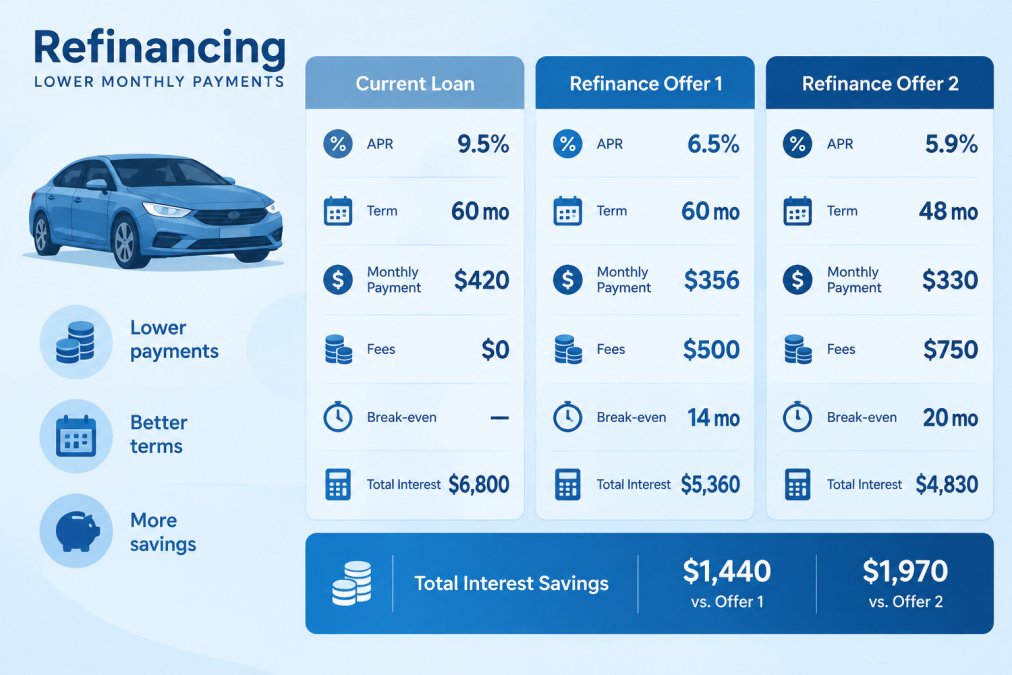
The table below sets out the four used-car refinance checks and what each one means for approval and pricing.
| Factor | What lenders look at | Why it matters |
|---|---|---|
| Credit score and history | Score and on-time payment record | Stronger credit usually earns a lower rate |
| Loan-to-value ratio | Loan balance compared with car value | Owing more than the car is worth makes approval harder |
| Vehicle age and mileage | Age and mileage limits set by lenders | Older or high-mileage cars may need a specialty lender |
| Remaining term | Months left on the current loan | Lenders set a maximum new term based on vehicle age |
How to Lower Car Payment With Bad Credit
Bad credit makes lower rates harder to get, but it does not rule out better terms. Focus on what you can control.
- Shop more than one lender: rates vary widely by credit profile.
- Bring a larger down payment: a bigger down payment lowers the amount you finance.
- Ask about a co-signer: a co-signer with stronger credit can improve your offer.
- Pay on time from now on: a clean record can help you refinance later.
Keep the total cost in view. A high-rate loan with a long term can cost far more than the payment suggests.
When You Can't Refinance: Alternatives That Actually Lower the Bill
If your credit or your car's age and mileage keep you out of a refinance, you still have options. These are the ones lenders and servicers actually use, and each has a real trade-off:
- Hardship or payment-modification programs: many servicers offer temporary reductions, deferrals, or modified terms for borrowers facing a documented hardship. Ask for the total cost of the change before you agree.
- Due-date changes: moving your payment date to align with your payday won't lower the amount, but it can stop late fees and missed payments that damage your credit further.
- Payment extensions: a short extension can free up cash this month, but interest usually keeps accruing and the loan can stretch longer.
- Selling or trading the vehicle: if you owe less than the car is worth, selling it and paying off the loan can eliminate the payment entirely. If you owe more, you'd need to cover the difference.
- Voluntary surrender: turning the car back to the lender sounds like an escape, but it typically doesn't erase the balance, the lender may sell the car and pursue you for the remaining amount, and it damages your credit. Treat it as a last resort, not a payment-lowering tool.
A common pattern is that borrowers with damaged credit get the most lasting relief by combining a short-term fix (a due-date change or hardship program) with a credit-rebuild plan, then refinancing once their score and LTV improve. That two-step approach beats chasing a lower payment you can't qualify for today.
Watch out: any company that promises to "erase" your auto loan or demands an upfront fee before negotiating is a red flag, legitimate help doesn't require paying a stranger first.
Use a Lower Car Payment Calculator Before You Decide
A car payment calculator shows how a new rate or term changes your monthly bill. Enter your balance, your current APR and your remaining months, then try a few alternatives.
Run at least three scenarios: a lower rate with the same term, the same rate with a longer term, and a rate and term combination you can actually qualify for. Compare the monthly payment and the total interest for each one. The calculator shows the trade-off in dollars, which makes the decision easier.
Remove Optional Add-Ons and Trim Your Loan Balance
Add-on products such as extended warranties, gap coverage and service plans are often rolled into the loan. Every dollar of those products is financed at your loan rate, so they raise your payment.
Ask your dealer or lender these questions:
- Is this add-on financed into my loan?
- Can I cancel it, and will I get a prorated refund?
- Do I still need this coverage?
Canceling an unneeded product can reduce the balance and the payment. Any cash you put toward principal also shrinks what you owe going forward.
Schedule Your Lower-Payment Plan at Buy & Buy Auto Sales
At Buy & Buy Auto Sales in Columbus, our team can walk you through financing options regardless of credit history, with no hidden fees and flexible terms, so you can see what a lower payment would really cost you. You can get pre-qualified in minutes and find out where you stand. Browse financing alternatives at Buy & Buy Auto Sales to compare your options, or learn how to get approved for a bad credit auto loan before you apply.
Frequently Asked Questions
Is there a way to lower monthly payment on a car loan?
Yes. The main levers are refinancing to a lower interest rate, extending the repayment term, making extra payments toward principal, and removing optional add-on products that were rolled into the loan. Each one changes the monthly figure differently. Longer loan terms generally lower the required monthly payment. A lower payment does not always mean a cheaper loan overall, so compare total interest before you change anything.
Can refinancing lower my used car loan payment?
It can, if you qualify for a lower interest rate or a longer term at a reasonable cost. Lenders typically look at your credit profile, the car's age and mileage, and how much you still owe compared with the vehicle's value. Before applying, ask about fees and compare the total cost of the new loan with what you would pay on your current one.
What happens if I pay an extra $100 a month on my car loan?
Extra payments go toward principal, which reduces the balance that interest is charged on. Over time this shortens the loan and lowers the total interest you pay, though it does not reduce your required monthly payment on its own. To lower the required payment, ask your lender to recast or modify the loan, or refinance. Confirm with your lender that extra funds are applied to principal and not treated as an advance on future payments.
How can I lower my car payment with bad credit?
Start by getting prequalified with several lenders, which uses a soft credit check and shows possible rates without a hard inquiry on your credit. Consider a longer term or a down payment to reduce the amount financed. At Buy & Buy Auto Sales, financing is available regardless of credit history, and you can get pre-qualified in minutes to see your options before committing.