 How-to
How to Negotiate Car Price at Dealership
Table of Contents
- Research Your Vehicle's Market Value Before You Visit
- Set Your Budget and Maximum Out-the-Door Price
- Understand Invoice Price, MSRP, and Dealer Markup
- Get Competing Quotes Before You Negotiate
- Use a Car Negotiation Script to Stay on Track
- How to Negotiate a Used Car Price Step by Step
- Step 1: Start with the Vehicle Price, Not Monthly Payments
- Step 2: Make Your Initial Offer Below Your Target
- Step 3: Let the Salesperson Counter and Respond Strategically
- Step 4: Build an Out-the-Door Worksheet Before You Compare Quotes
- Step 5: Negotiate the Out-the-Door Total, Not Just the Vehicle Cost
- Step 6: Handle Trade-Ins and Financing Separately
- Step 7: Review the Final Contract Line by Line
- How Much Will Dealers Come Down on Used Cars
- Common Mistakes to Avoid During Negotiation
- Frequently Asked Questions
Last Updated: October 15, 2026
Research Your Vehicle's Market Value Before You Visit
Before stepping onto a dealership lot, know what the car is actually worth, this is your foundation for how to negotiate car price dealership.
Pull the vehicle's year, make, model, mileage, and condition, then check multiple sources for what similar cars sell for in your area. Look at recent sales, not asking prices.
Set Your Budget and Maximum Out-the-Door Price
Most buyers think about monthly payments, that's the trap. Dealers want you focused on the payment because it hides the real cost. Instead, set a maximum out-the-door price: the vehicle cost plus taxes, registration, documentation fees, and add-ons. Know your maximum and you control the conversation.
Here's how to set it:
- Decide what you can actually afford to pay in total
- Subtract taxes and fees (roughly 8-12% depending on your state)
- That's your maximum vehicle price
Understand Invoice Price, MSRP, and Dealer Markup
Three numbers control car pricing: MSRP, invoice price, and dealer markup.
MSRP is the manufacturer's suggested retail price on the window sticker, the starting point for negotiation, not the final price.
Invoice price is what the dealer paid the manufacturer, lower than MSRP.
Dealer markup is the profit built into the asking price. On used cars it varies widely depending on demand and condition.
Your goal: negotiate toward invoice price, not MSRP.
Get Competing Quotes Before You Negotiate
Never negotiate with one dealership. Get quotes from at least two or three.
With a competing quote, you can say: "I have an offer for this same vehicle at $X from another dealer. Can you match or beat it?" Most dealers negotiate harder when competing for your business.
Here's the process:
- Find the same vehicle (or very similar) at multiple dealerships
- Get a written quote from each one
- Include the out-the-door price, not just the vehicle price
Dealers expect this. If one refuses to negotiate when you show a competing offer, walk.
Use a Car Negotiation Script to Stay on Track
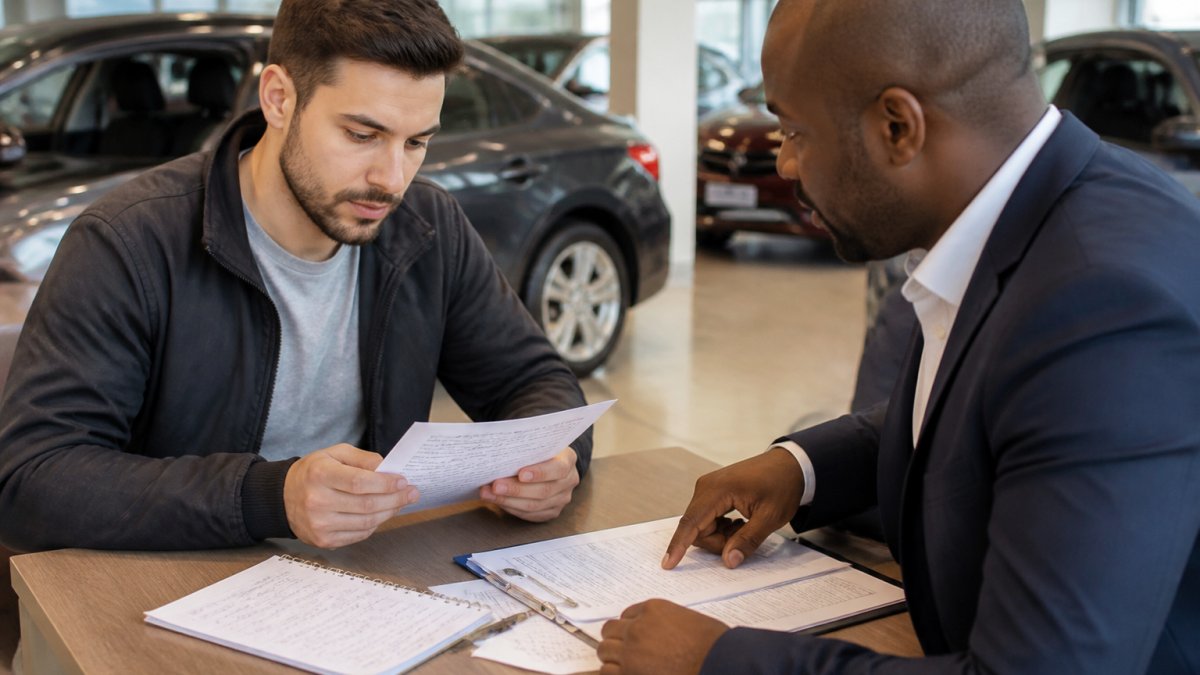
Emotions run high at dealerships, and salespeople are trained to read you. A script keeps you calm and focused, not robotic, just prepared so you don't freeze or cave under pressure.
Opening the Negotiation
You: "I'm interested in this vehicle. I've done my research and I know what similar cars are selling for. I'm ready to make an offer today if the price is right."
This signals you're a serious buyer with market data, and puts a clock on the conversation without being aggressive.
When They Quote a Price Above Market
You: "That's higher than what I'm seeing in the market. I have written quotes from other dealers at [X price] for the same trim and mileage. What's your best out-the-door number?"
Always ask for the out-the-door number, not the vehicle price, that forces them to show taxes, fees, and add-ons in one comparable figure.
When They Pivot to Monthly Payments
The most common deflection: "Forget the total, what monthly payment works for you?"
You: "I'm not shopping for a payment. I'm shopping for a total price. Once we agree on the out-the-door number, I'll be happy to talk financing."
Repeat as needed. If they keep pushing the payment, they're likely hiding a longer loan term or higher rate.
When They Say "Let Me Talk to My Manager"
This is a pressure tactic, the manager already set the floor before you arrived.
You: "Take your time. While you're back there, here's my number: [your target out-the-door price]. If you can hit it, I'll sign today."
Giving a firm number before they leave prevents the classic back-and-forth where each manager trip shaves off a tiny amount.
When They Push Add-Ons at the Finance Desk
After you agree on price, the finance manager will pitch paint protection, extended warranties, gap insurance, and tire-and-wheel coverage, almost always negotiable and often marked up.
You: "I'm only signing for the vehicle at the agreed out-the-door price. I'll decline all add-ons today.
You can buy most of these elsewhere for less, gap insurance, for example, is often available through your auto insurer.
When They Won't Budge
You: "I understand. Let me shop around a bit more and I'll get back to you if your price works."
Then actually leave. A dealer who lets you walk is either at their real floor or betting you'll return. Either way, you lose nothing by checking the next lot.
When You're Ready to Close
You: "I'll sign today at [your number] out-the-door, with no add-ons and financing at [your rate] for [your term]. Can we do that?"
Putting every term in one sentence prevents the dealer from re-opening something you thought was settled.
Practice out loud before you go so the words are ready when you're on the lot.
How to Negotiate a Used Car Price Step by Step
Negotiating car price at dealership follows a specific sequence. Skip steps or do them out of order, and you'll lose leverage.
Step 1: Start with the Vehicle Price, Not Monthly Payments
The salesperson will try to talk about monthly payments early. Don't take the bait. Say: "Let's figure out the vehicle price first. Then we can talk about financing."
Monthly payments can hide a bad deal, a low payment might mean a longer loan term or a higher interest rate. Separate the vehicle price negotiation from the financing negotiation.
Step 2: Make Your Initial Offer Below Your Target
Your target price is based on your market research. Your initial offer should be 5-10% below that target, giving you room to negotiate up. Dealers expect this. They'll counter higher. That's the negotiation. Never open at your maximum price, you've lost all negotiating room if you do.
Step 3: Let the Salesperson Counter and Respond Strategically
The salesperson will come back with a higher number. Let them. Listen without emotion and don't say "yes" or "no" immediately.
Instead, say: "That's closer, but still higher than I'm comfortable with.
Each counter should move closer to your target, not jump to it. If they jump $500 on their first counter, they'll jump again.
Step 4: Build an Out-the-Door Worksheet Before You Compare Quotes
This is the step most buyers skip, and it's the one that saves the most money. A single "out-the-door price" hides where the money is going.
Open a spreadsheet or a sheet of paper and create these rows:
- Vehicle selling price, the negotiated price of the car itself, before anything else
- Sales tax, calculated on the vehicle price (and sometimes on rebates or trade-in, depending on your state)
- Registration and title fees, set by your state motor vehicle agency, not negotiable
Ask each dealer to send a written quote broken out into these same lines. When one quotes a lower vehicle price but a higher documentation fee, your worksheet shows the real difference.
Step 5: Negotiate the Out-the-Door Total, Not Just the Vehicle Cost
Once you have itemized quotes, negotiate against the total. Some dealers give a strong vehicle price then load up documentation fees, add-ons, or prep charges, and you pay more than you planned.
If the out-the-door total is higher than your budget, negotiate the vehicle price down further, or ask them to remove specific add-ons line by line.
Step 6: Handle Trade-Ins and Financing Separately
If you're trading in a vehicle, negotiate its value separately from the new car price. Dealers will try to bundle them: "We'll give you $8,000 for your trade-in if you pay $18,000 for this one."
That's a trap. You don't know if you're getting a fair trade-in value or a fair car price. Negotiate each one independently:
- "What's your best price on this vehicle?" Get that number.
- "What's your best offer on my trade-in?" Get that number separately.
- Then do the math: new car price minus trade-in value equals what you pay.
Same with financing. Lock in the vehicle price first, then talk loan terms, interest rates, and monthly payments.
Step 7: Review the Final Contract Line by Line
Before you sign, compare the final contract against your worksheet. Every line should match what you agreed to. If a new fee appeared, or an add-on you declined is still there, stop and ask them to remove it. Once you sign, the terms are locked in.
How Much Will Dealers Come Down on Used Cars
There's no fixed percentage.
Cars in high demand (popular models, good condition, low mileage) have less negotiating room.
Cars in lower demand (older, higher mileage, less popular) have more room. Dealers need to move inventory.
Cars that have been on the lot for 30+ days are your best negotiating opportunity.
Common Mistakes to Avoid During Negotiation
Focusing on monthly payments instead of total price. The biggest mistake.
Negotiating alone. Bring someone with you.
Accepting the first offer. Dealers expect negotiation.
Ignoring the out-the-door price. Fees add up fast.
Negotiating late in the day. Tired salespeople make worse decisions.
Negotiating car price at dealership is a skill, not an art.
Frequently Asked Questions
Are you supposed to haggle at a car dealership?
Yes, negotiating the car price at dealership is expected and standard practice. Most dealerships build markup into their asking price, giving room for negotiation. The key is approaching it professionally and armed with research on the vehicle's market value, competing quotes, and your maximum budget. Dealers expect buyers to negotiate, and many salespeople are trained to handle counteroffers. Walking in prepared signals you're a serious buyer and strengthens your negotiating position.
What is the best way to finance a car?
Separate your vehicle price negotiation from financing discussions. First, agree on the total car price and out-the-door cost. Then discuss financing options, interest rates, and loan terms. Get pre-qualified before visiting the dealership so you know your budget and credit standing. Compare financing offers from banks or credit unions against dealer financing. Longer loan terms lower monthly payments but cost more in interest over time. Always negotiate the vehicle price before discussing monthly payments, as dealers often use payment figures to obscure the true cost.
How do you negotiate a car price using competing offers?
Obtain written quotes from at least two other dealerships for the same vehicle or comparable models. Bring these quotes with you or reference them during negotiation. Tell the salesperson you have competing offers at lower prices and ask if they can match or beat them. This creates negotiating leverage and shows the dealership you've done your homework. Be honest about the competing offers but don't bluff, dealers can often tell. A genuine competing quote is one of the strongest tools in your negotiating toolkit.
What should you say when negotiating a car price?
Start by saying: 'I'm interested in this vehicle, but I've researched the market value and found comparable cars priced lower elsewhere.' Then make a specific, written offer below your target price. When the salesperson counters, respond with: 'I appreciate the counteroffer, but that's still above what I'm prepared to pay based on the vehicle's condition and market comparables.' Stay calm, use numbers, and avoid emotional language. If they won't budge, be ready to walk away by saying: 'I understand. If you can get closer to my number, I'm ready to buy today.'