 blog
blog
Ricart vs Auto Boutique: Which Dealership Fits Your Needs
Table of Contents
- Ricart vs Auto Boutique: Quick Comparison
- Dealership Overview and Vehicle Inventory
- How to Compare Used Car Dealerships: What Matters Most
- Financing and Credit Approval: What Each Dealership Offers
- Used Car Inspection Checklist Before You Buy
- Questions to Ask When Buying a Used Car
- Customer Reviews and Buying Experience
- Which Dealership Should You Choose?
- Frequently Asked Questions
Last Updated: October 5, 2026
Ricart vs Auto Boutique: Quick Comparison
Shopping for a used car in Columbus means comparing dealerships. Ricart and Auto Boutique are two established names, but they operate very differently. Knowing what each brings helps you pick based on your budget, credit, and priorities.
This guide breaks down Ricart vs Auto Boutique for used cars, covering inventory, financing, inspection standards, and the buying experience at each.
Dealership Overview and Vehicle Inventory
Most pages stop at "one is big, one is small." Here's the head-to-head breakdown that actually helps.
The structural difference
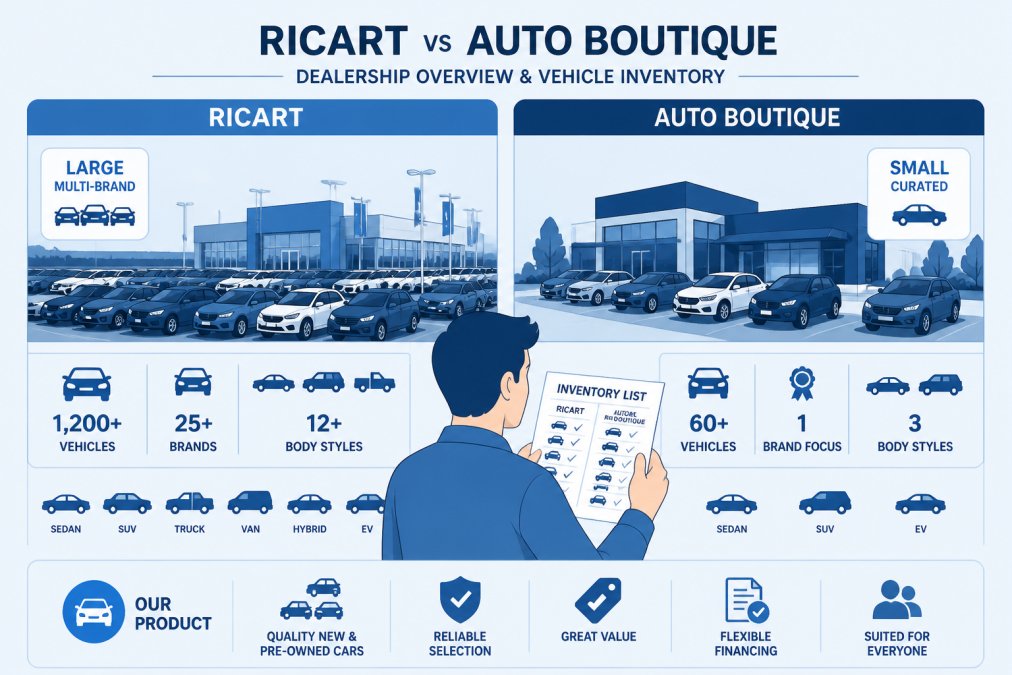
Ricart runs a high-volume, multi-franchise store. Used inventory sits alongside new and pulls from trade-ins, lease returns, and auctions across many brands, sedans, trucks, SUVs, crossovers, and the occasional oddball, across a wide range of model years and price points.
Auto Boutique runs a lean, curated lot. Vehicles are hand-picked, typically newer and lower-mileage, skewing toward commuter and family segments, compact and midsize SUVs, sedans, a few trucks. No 12-year-old project cars, no 40 variations of the same model.
How to compare them by what you actually need
Don't compare total unit counts. Compare against your own filter. Run the same search on both sites and track four numbers:
- Budget band. Set a ceiling and floor. A high-volume lot has more units under a given ceiling; a curated lot has fewer but often cleaner examples.
- Body style. Need a three-row SUV, crew-cab truck, or hatchback? The bigger lot wins on availability. Need a reliable commuter? The curated lot may have a better hit rate per vehicle viewed.
- Mileage window. Curated lots cluster in lower mileage. Volume lots span the spectrum, including high-mileage units that price lower but carry more risk.
- Title status. Ask both stores, in writing, whether any unit has a rebuilt, salvage, or branded title. It's the most important inventory question and almost nobody asks it up front.
Verify before you drive
Inventory pages go stale. Before you make a trip:
- Call and confirm the specific stock number is still on the lot.
- Get the VIN over the phone and run it through a vehicle history provider.
- Ask whether the listed price includes reconditioning or is "as-is."
- Ask how long the unit has been on the lot. A vehicle sitting 90+ days is a negotiation lever; one listed yesterday is not.
What this means for you
If your must-have list is specific and unusual, the volume store is the safer bet. If it's short and quality-focused, the curated store may get you to a decision faster with less lot fatigue. Either way, the phone call and VIN check are what protect you.
How to Compare Used Car Dealerships: What Matters Most
Comparing used car dealerships means looking beyond price. Several factors determine the right fit.
Vehicle condition and inspection standards matter most. Ask about their multi-point inspection process: what do they check, and do they replace worn parts or sell as-is?
Transparency on pricing is your second checkpoint. Request an itemized out-the-door breakdown, vehicle price, dealer fees, documentation fees, add-ons. Hidden costs are a red flag.
Financing flexibility determines whether you drive home. Can they work with your credit situation, offer multiple lenders, and flex on down payment?
Customer service responsiveness shows up in how fast they answer questions, whether salespeople pressure you, and how they handle post-purchase issues.
Inventory transparency matters if you have specific needs.
Financing and Credit Approval: What Each Dealership Offers
Financing is where the two stores diverge most. Most results either list "bad credit OK" or punt to a generic credit-score explainer. Here's the mechanics-level comparison.
How each store structures lending
A high-volume, multi-franchise store typically has a finance department wired into a broad lender network, captive finance arms, national banks, regional banks, credit unions. That breadth helps most when your credit is solid: more lenders competing means more chances at a lower rate and longer term.
A smaller, curated store leans on a narrower but more specialized lender panel, including non-prime and near-prime lenders that underwrite on more than FICO, income stability, down payment, prior auto loan history. That helps most when your file is thin, bruised, or non-traditional.
Neither structure is universally better. The right question is: which one has a lender that will approve your file at a term you can live with?
Prequalification: what to expect and what to ask
Both stores should prequalify you without a hard pull. Prequalification uses a soft inquiry and gives you a rate and term range, it commits neither side.
Ask each store these five questions before you share your SSN:
- Is this a soft pull or a hard pull? Soft for prequal, hard only when you're ready to sign.
- How many lenders will see my application? More lenders means more rate shopping, but also more inquiries if it goes to hard pull.
- What are the stipulations? Proof of income, residence, references, down payment verification, get the list up front.
- What's the maximum term you'll write? Longer terms lower the payment but raise total interest and can leave you underwater.
- Is there a prepayment penalty? You want the answer to be no.
Compare offers on the same vehicle
The only fair comparison is same vehicle, same down payment, same term. Ask both stores to quote a specific stock number you've already seen, then compare:
- APR, not just monthly payment.
- Total finance charge over the loan's life.
- Term length and whether it exceeds the vehicle's useful life.
- Down payment required and whether it's negotiable.
- Add-ons bundled in, gap insurance, extended service contracts, tire-and-wheel, paint protection. These are separate products you can decline.
Bad-credit and non-prime shopping
If your credit is challenged, the practical differences matter more than the marketing:
- Down payment flexibility. Non-prime approvals usually hinge on how much you put down. Ask the minimum and whether a trade-in counts.
- Income documentation. Non-prime lenders often want proof of income, recent pay stubs or bank statements. Have them ready.
- Co-signer options. Ask whether a co-signer moves you into a better tier. Sometimes it does; sometimes it doesn't.
- Rate shopping window. Multiple auto loan inquiries in a short window are typically treated as one inquiry by scoring models, so rate shopping is generally safe, but confirm with the lender (How will shopping for an auto loan affect my credit?).
Bring your own financing too
Before you walk in, get a preapproval from your own bank or credit union. It costs nothing, gives you a rate to beat, and turns the dealer's finance office into a competitor rather than the only option. Even if you finance through the store, you'll negotiate from information instead of hope.
At Buy & Buy Auto Sales, we built our financing around exactly this reality: stress-free approvals regardless of credit history, transparent pricing with no hidden fees, flexible down payment options, and a process fast enough that you're not stuck at a desk for hours. Get prequalified in minutes and see which vehicles fit your budget, no judgment, no games.
Used Car Inspection Checklist Before You Buy
Before buying any used vehicle, inspect it yourself regardless of what the dealership claims. It protects you from buying a problem car.
Exterior inspection starts with walking around in daylight.
Under the hood, check fluid levels and condition. Oil should be amber to brown, not black. Coolant pink or green, not rusty. Look for leaks under the engine.
Interior inspection covers driver's seat wear, dashboard cracks, and electronics. Test A/C, heating, windows, locks, and lights. Interior neglect often signals mechanical neglect too.
Test drive reality check means highways, local streets, and parking lots.
Vehicle history report should come from both dealerships. It shows accident history, title issues, and prior ownership, your insurance against hidden problems.
Questions to Ask When Buying a Used Car
Asking the right questions separates informed buyers from those who get surprised later. Come prepared.
"What's your return or exchange policy?" Some dealerships offer a limited return window; others have no recourse.
"Are there any known issues with this vehicle?" Honest dealerships disclose problems.
"What warranty or protection plan comes with this vehicle?" Some include extended warranties; others sell them separately. Understand what's covered and what isn't.
"Can I have this vehicle inspected by my own mechanic?" Reputable dealerships allow pre-purchase inspections. If they refuse, walk away.
"Are there any dealer fees I should know about?" Get a complete breakdown.
Customer Reviews and Buying Experience
Customer reviews reveal patterns that matter. Look beyond star ratings to actual feedback.
Ricart reviews highlight large inventory and competitive pricing.
Auto Boutique reviews emphasize personalized service and lower-pressure buying.
Review count matters. Hundreds of reviews means volume; fewer might mean less transparency or a smaller operation. Neither is inherently better, it depends on your priorities.
Recent reviews are most relevant. A dealership that treated customers well two years ago may have changed management. Focus on the last three to six months.
Specific feedback beats generic praise. "Great experience" is less useful than "salesman explained financing clearly and didn't pressure me." Look for concrete details about the buying process.
Which Dealership Should You Choose?
Your choice depends on your situation and priorities. There's no universal "best" dealership, only the best fit.
Choose Ricart if: You want maximum inventory, have good credit and qualify for traditional financing, are comfortable with a larger dealership, and prioritize price competition.
Choose Auto Boutique if: You prefer personalized service, have credit challenges and need flexible financing, want a lower-pressure experience, and value quality over quantity. Their smaller operation often means more attention to your situation.
Consider Buy & Buy Auto Sales if: You need stress-free financing regardless of credit history, want no hidden fees and transparent pricing, value down payment flexibility, and want the process done quickly.
Frequently Asked Questions
What's the real difference between Ricart and Auto Boutique for used cars?
Both dealerships offer pre-owned vehicle selection and financing, but they differ in inventory size, credit flexibility, and customer service approach. Ricart operates as a larger, multi-location dealership with extensive inventory across vehicle makes and models. Auto Boutique focuses on a curated selection with a boutique-style buying experience. Your choice depends on whether you prioritize maximum selection or personalized attention. Visit both to compare their current vehicle inventory, financing terms, and how their teams treat you during the buying process.
Can I get approved for a used car loan with bad credit at either dealership?
Both dealerships work with buyers who have credit challenges, but their approval processes and lender networks differ. Ricart, as a larger operation, may have access to more lender options and specialized bad-credit financing programs. Auto Boutique may offer more flexible, personalized financing conversations. Before committing, ask each dealership directly about their credit requirements, available lenders, down payment flexibility, and whether they can pre-qualify you. Getting pre-qualified in minutes helps you understand what each dealership can actually offer your specific credit situation.
How do I know which dealership has better vehicle condition and reliability?
Both should conduct multi-point inspections and provide vehicle history reports. Ask each dealership about their reconditioning process, what their inspection covers, and whether they offer extended warranty or repair protection options. Request the vehicle history report before purchasing, and consider having an independent mechanic inspect any pre-owned vehicle you're seriously considering. Don't rely solely on the dealership's assessment, your own inspection checklist and third-party verification protect you from hidden issues.
What questions should I ask to ensure I'm getting a fair deal?
Ask about the out-the-door purchase price (including all dealer fees and taxes), what's covered under any warranty, the return or exchange policy, how long you can hold a vehicle before purchase, and trade-in value if you're trading in your current car. Request an itemized breakdown of all costs. Ask about their financing terms, monthly payment estimates, and whether there are any hidden fees. Understanding these details upfront prevents surprises and helps you compare offers transparently between dealerships.
The right dealership choice depends on matching your priorities, inventory size, financing flexibility, buying experience, and price, with what each dealership actually delivers. Visit both, ask questions, and choose based on how each treats you, not just their reputation.